

In my last post, we looked at some of my favourite tips for helping you to learn English. Today, we’re going to look at a few more!
- Label Everything
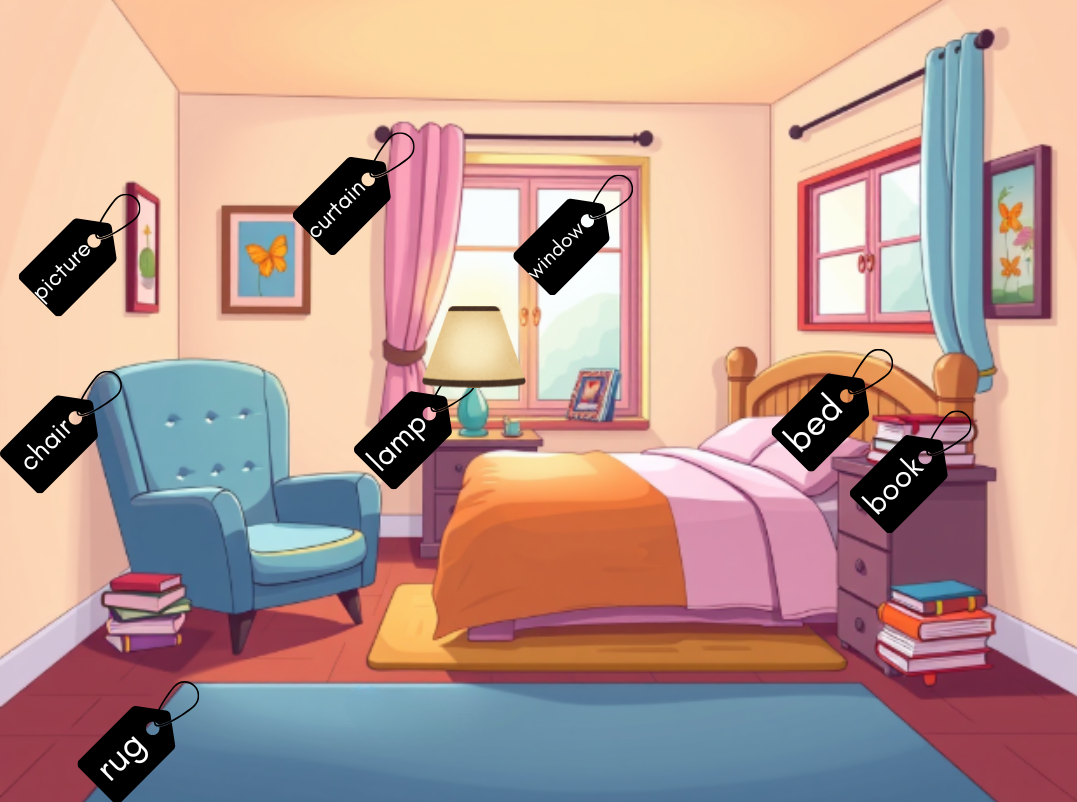
It’s a real challenge to learn new vocabulary when you’re learning a language, so one trick for beginners is to label everything around the home with the English word.
Put a sticky note on the item so that you can see it every time you look at the object: door, bed, chair, cupboard, book – you get the idea! Gradually, your brain will absorb the information that the word and the object go together. You will be creating a visual memory, which will hopefully also help you remember how to spell the word.
In the future, whenever you see that word in a text, you will automatically visualise the image from your home, and you’ll know what the word means without even thinking about it.
- Make Mistakes

This one sounds counter-intuitive but it’s actually beneficial to your learning to make mistakes.
If you wait until you are sure that your sentence is “perfect English”, you will never be brave enough to speak, or you will only ever say sentences that your teacher has provided. Your written work will be boring and unimaginative. By being afraid of making mistakes, you are limiting your potential, and you will never be as good at English as you could otherwise be.
If you are brave enough to try and use your English, knowing that you will probably make mistakes, you are more likely to succeed.
Why? Well, when you make a mistake, your teacher will correct you, and you can then learn the correct way to say or write things. The more you practise, the more you will understand how you should be using English, and so you will begin to improve.
Aim to use English, even if you’re not sure how to use it correctly. Embrace your mistakes, and watch your skills improve!
- Learn More Adjectives and Adverbs

Adjectives are often referred to as “describing words”. They add more information to a noun or pronoun. Meanwhile, adverbs can provide more information about a verb, another adverb, an adjective, a clause or even a whole sentence.
When we use adjectives and adverbs, we can make our spoken or written English more informative and therefore, more interesting for our audience.
For example, if we say, “The dog ate a bone,” we don’t know anything about the dog or the bone. What size is the dog? What colour? What is the dog’s temperament? As for the bone – what is it like? If we say, “The small, brown dog hungrily ate a huge, meaty bone,” we can start to visualise the dog in our minds. I can imagine that the bone is far too big for the dog, perhaps it’s even bigger than the dog!
Learn a new adjective or adverb every day, and remember to use them when you are writing or speaking – not too many at once though, no more than one adverb or three adjectives in a row!
If you spend some time working on this tip, you’ll soon be able to paint pictures with your words!
- Play Word Games

Now that you have learnt some adjectives and adverbs to go along with all of the nouns you know, practise using them! You don’t have to write essays or give speeches to practise your vocabulary, you can play games.
Yes, you read that correctly – playing word games is a fantastic way to build your knowledge of both vocabulary and parts of speech, and have fun doing it. It’s homework, but not as you know it! 😂
Mad Libs can be played alone, or with friends and family. What are Mad Libs? They are stories that require you to fill in the gaps: create a list of nouns, verbs, adjectives and adverbs according to the provided instructions, and fill in the blanks in the story – the results are usually very funny. Don’t look at the story before you create the list though, or you’ll spoil the surprise! You can buy a book, or search online for a Mad Libs story to play, or if your level is more advanced, you could even create your own story for friends to complete!
Scrabble is another wonderful game for improving your vocabulary and spelling skills. You can play against a computer, or use a game board to play with family and friends. Use a dictionary to check spellings, and look up words that you are not familiar with.
If you don’t have a game or computer to hand, there are other games that you can play with just a pencil and a piece of paper: Hangman is very popular and is a great way to spend time on a car or train journey, or even during a break period at school: one person thinks of a word and draws lines on the paper to represent the number of letters: _ _ _ _ _ (a five-letter word) The other person guesses letters, one at a time, to try and work out what the word is. You can give a clue, such as the category “animals” or “countries” to help your partner guess more easily. Each time they guess a letter correctly, fill in the space(s) in the word but if they get a letter wrong, you start to draw your hangman image. Guess the word before the victim is killed!
Word chain does not even require a piece of paper and can be played alone or with a group of people: the first person says a word, for example, “apple”, then the next person has to think of a word beginning with the last letter of that word (in our example, the last letter is “e”, so you might say “elephant.”) How long can you keep going before you have to give up?
(🤫Parents: you can encourage your kids to play these games and they will never guess that they are studying!)
Have you already tried any of these tips? Do you enjoy playing any other word games? Let me know in the comments below, and I’ll be back again soon with some more of my favourite tips!
 Fern's English
Leave a comment